
Seward County Court Records After Arrest
Seward County court records after an arrest usually start with a law-enforcement report and booking at the county jail. The Seward County Attorney then reviews cases from the Seward County Sheriff's Office, Liberal Police Department, Kansas Highway Patrol, KBI, DEA, ATF, INS, SRS, and other agencies listed by the office. If charges are filed, the court record moves through the 26th Judicial District unless the matter belongs in Liberal Municipal Court. That difference matters. A jail booking can show the reason a person was held, while the court record shows what the prosecutor filed and what the judge did with the case.
For the custody side, use Seward County jail inmate records to confirm whether a person is still held. For booking photos, use Seward County jail mugshots because the court file is not a mugshot gallery. Court records after a jail arrest are best read as the formal case trail: complaint, first appearance, bond, case management, preliminary hearing, arraignment, trial, plea, diversion, dismissal, or sentence. A charge is an accusation. A conviction comes only after a plea or verdict.
The county's criminal process page is the local roadmap for that path. It says first appearance is when charges are explained, counsel is usually appointed, and the next date is set. Later events may include case management, a felony preliminary hearing, arraignment, trial, sentencing, plea negotiation, or diversion.
Find Seward County Arrest Court Records
The public court search starts with Kansas District Court CaseSearch, the statewide portal for district court records. Search once a prosecutor has filed the case. If the arrest is too recent, the jail may know custody and bond status before the case appears online. If the case is older, sealed, restricted, or not visible through the portal, contact the Seward County District Court clerk. Liberal municipal matters are different from district court matters, so a Liberal Police citation or city ordinance arrest may require Liberal Municipal Court instead of the district clerk.
- Confirm the custody issue first through Seward County Jail at 620-309-2000 or Kansas VINE if the question is whether the person is still in county jail.
- Decide which court fits the arrest. Liberal municipal violations may proceed in municipal court, while county and state crimes go to Seward County District Court.
- Search Kansas CaseSearch by party name, case number, citation, or business name once a case has been filed.
- Open the case result and compare the filed charges with any booking charge, because the prosecutor may amend, reduce, dismiss, or divert charges later.
- Call the District Court Clerk for records not visible online or for help with older public files.
The District Court page lists the clerk as Donna L. Odneal at 415 N Washington, Suite 103, Liberal, KS 67901. The main phone is 620-626-3375, and the court lists hours of Monday through Friday, 8 a.m. to noon and 1 p.m. to 5 p.m. The County Attorney is at 415 N Washington, Suite 106-107, Liberal, KS 67901, phone 620-626-3225. That office handles felony crimes, drug crimes, domestic batteries, juvenile crimes, and traffic prosecutions.
The manifest image below comes from the official Kansas District Court CaseSearch portal, which is the statewide search gateway for filed district court cases.
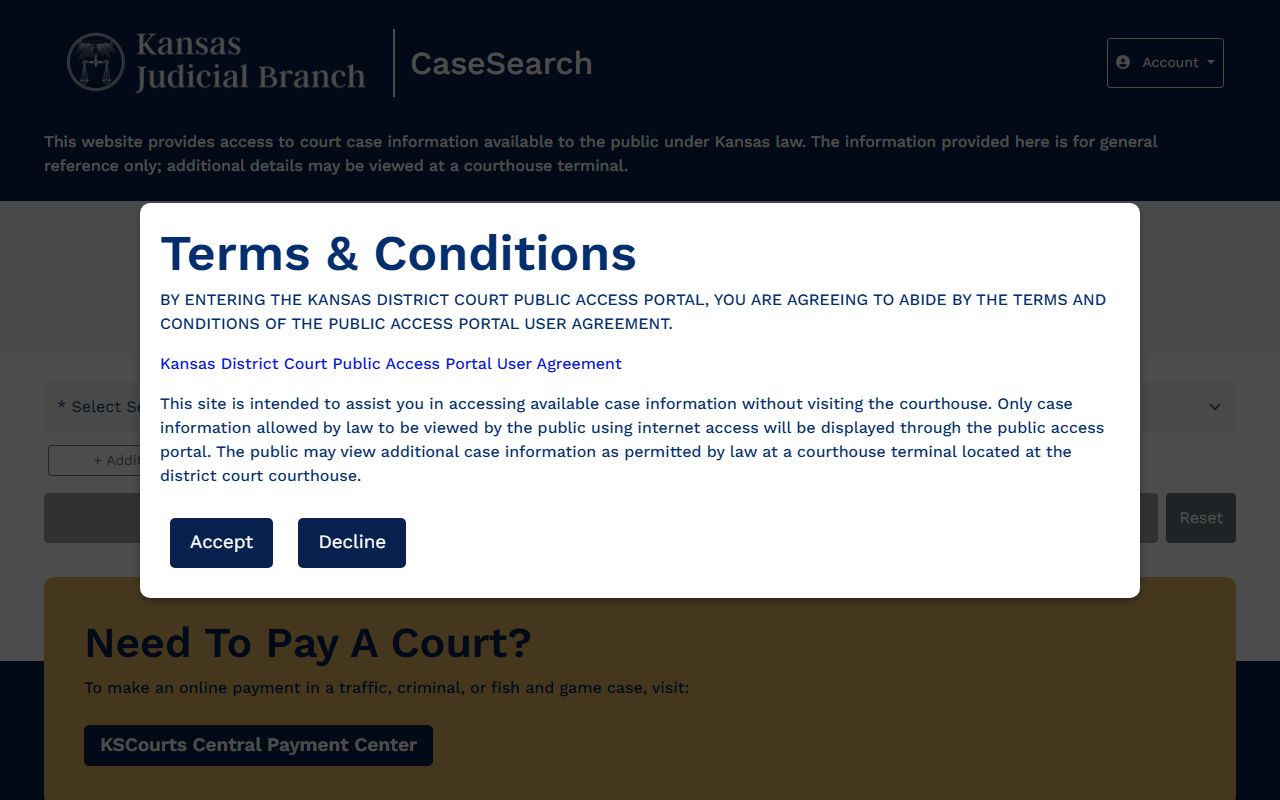
Use the portal for filed court records, then use the district clerk or the county KORA process when the record is not available through online search.
Seward County Court Search Fields
Kansas CaseSearch supports several search paths. The exact public view can depend on the case type, role, and portal terms. The research found these field labels and search options for court records after a jail arrest in Seward County.
| Field Label | Type | Required | Notes |
|---|---|---|---|
| Case number | Text search | Unspecified | Useful when a jail, attorney, bond company, or clerk has already provided the case number. |
| Party name | Text search | Unspecified | Use the defendant's legal name and check spellings, hyphenated names, and middle initials. |
| Business name | Text search | Unspecified | Relevant for business parties, not most jail arrest cases. |
| Citation | Text search | Unspecified | Helpful for traffic or citation-based charges that become district cases. |
| Other criteria by role | Role-based | Varies | Access can vary for public users, attorneys, agencies, and other authorized roles. |
| Terms and conditions | Acceptance notice | Likely yes | Remote court-record access is subject to the Kansas courts public access terms. |
Seward County Arrest Charging Records
After a Seward County jail arrest, the booking reason may be broad or preliminary. The formal court record begins with a charging document. The County Attorney may file a complaint, proceed by information after a felony preliminary hearing or waiver, or use an indictment if a grand jury is involved. The terms sound similar, but they sit at different points in the criminal process.
| Document | Who Files It | How It Fits the Case |
|---|---|---|
| Complaint | Commonly filed by the prosecutor to start a Kansas criminal case | Often the first formal charge record after arrest and first appearance. |
| Information | Filed by the prosecutor | Often used after preliminary hearing, bindover, or waiver in felony cases. |
| Indictment | Grand jury | A grand-jury charge, less common than prosecutor-filed charges in many local cases. |
Case events then follow the county process: first appearance, case management, preliminary hearing for felonies, arraignment, trial, sentencing, plea negotiation, or diversion. Diversion is not a conviction if completed as ordered, but it still can appear in court records while the case is active. The local page states that plea negotiations may lead to reductions or dismissals when facts change, evidence becomes unavailable, or witnesses cannot be located.
Seward County Charge Status Records
A charge status table helps explain why court records after a jail arrest may not match the original booking entry. A person may be booked on one allegation, then charged with a different offense. The prosecutor may add counts, reduce the level, dismiss one count, or file diversion. Always read the latest docket event and disposition before treating an old charge line as the current status.
| Status | What It Means | Why It Matters |
|---|---|---|
| Pending | The charge is still active and has not reached final disposition. | Future hearings, bond terms, or plea talks may still change the case. |
| Amended or reduced | The filed charge changed after review, hearing, plea talks, or evidence review. | The original arrest reason may no longer be the charge being prosecuted. |
| Dismissed | The charge was dropped by the court or prosecutor. | A dismissal is not the same as an expungement or sealed record. |
| Diversion filed | The defendant enters a program or agreement in eligible cases. | Successful completion typically results in dismissal of charges. |
| Convicted or sentenced | The case ended by guilty plea, verdict, or sentence. | If prison is imposed, custody tracking may move from county jail to KDOC KASPER. |
The official Seward County criminal process page shows the county-level sequence that drives these status changes.
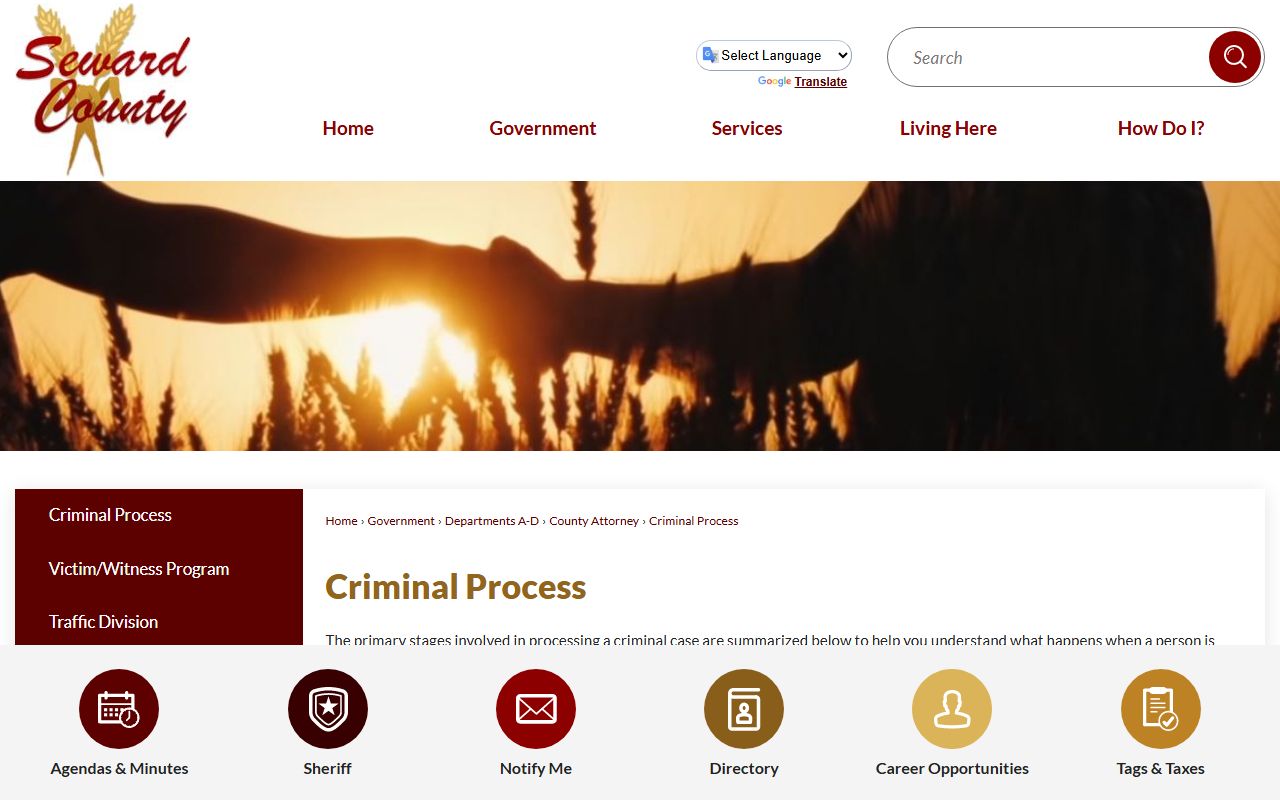
The local process source is useful when a case result lists a hearing name but does not explain what that stage means.
Bond Records After Seward County Arrest
Bond records connect the jail side and the court side. The City of Liberal Jail, Warrants and Bonding Information page says defendants arrested for municipal court violations are held at Seward County Jail and that all bonds for those municipal detainees are posted at the jail. People helping with release are told to contact the jail to determine whether the person is held and the bond amount. District cases may show bond orders, changes, revocations, or warrant entries in the court record.
| Bond Type | Local Meaning |
|---|---|
| Cash bond | Money is posted by the defendant or another person. If forfeited in Liberal municipal court, funds transfer to the City of Liberal. |
| Surety bond | A bondsman or surety posts under an agreement with the defendant and may impose additional requirements. |
| Own-recognizance bond | The defendant signs as defendant and surety without cash or a bondsman when the judge or local rule allows it. |
| Bench warrant fee | The Liberal page lists a $50 fee when a bench warrant is issued for failure to appear. |
Bond can change after first appearance. A detainer or hold is different from a regular bond. It means another agency or case may keep the person in custody even if one case has a bond. Confirm release with the jail before assuming a paid bond ends all custody.
Warrants Before Seward County Arrest
No official Seward County Sheriff's Office active warrant search was located in the county pages reviewed. Liberal Municipal Court does publish local warrant and bonding information for municipal cases. The page says a bench warrant may issue after failure to appear, and it gives Liberal Police Department warrant officer numbers: 620-626-0565 and 620-626-0575 for Spanish-speaking persons. District court warrants may appear as docket entries when public, but the safer route is the District Court Clerk or legal counsel.
Use a layered warrant lookup: Liberal Municipal Court for city warrants, the Sheriff's Office for county custody and sheriff warrant questions, the District Court Clerk for district case bench warrants, Kansas CaseSearch for filed case entries, and a KORA request when a public record is not posted. Some bench warrants may be recalled after voluntary appearance or after probation, diversion, or revocation issues are resolved, but only the proper court can confirm that status.
The official Liberal source below is the municipal jail, warrants, and bonding page that ties city arrestees to Seward County Jail.
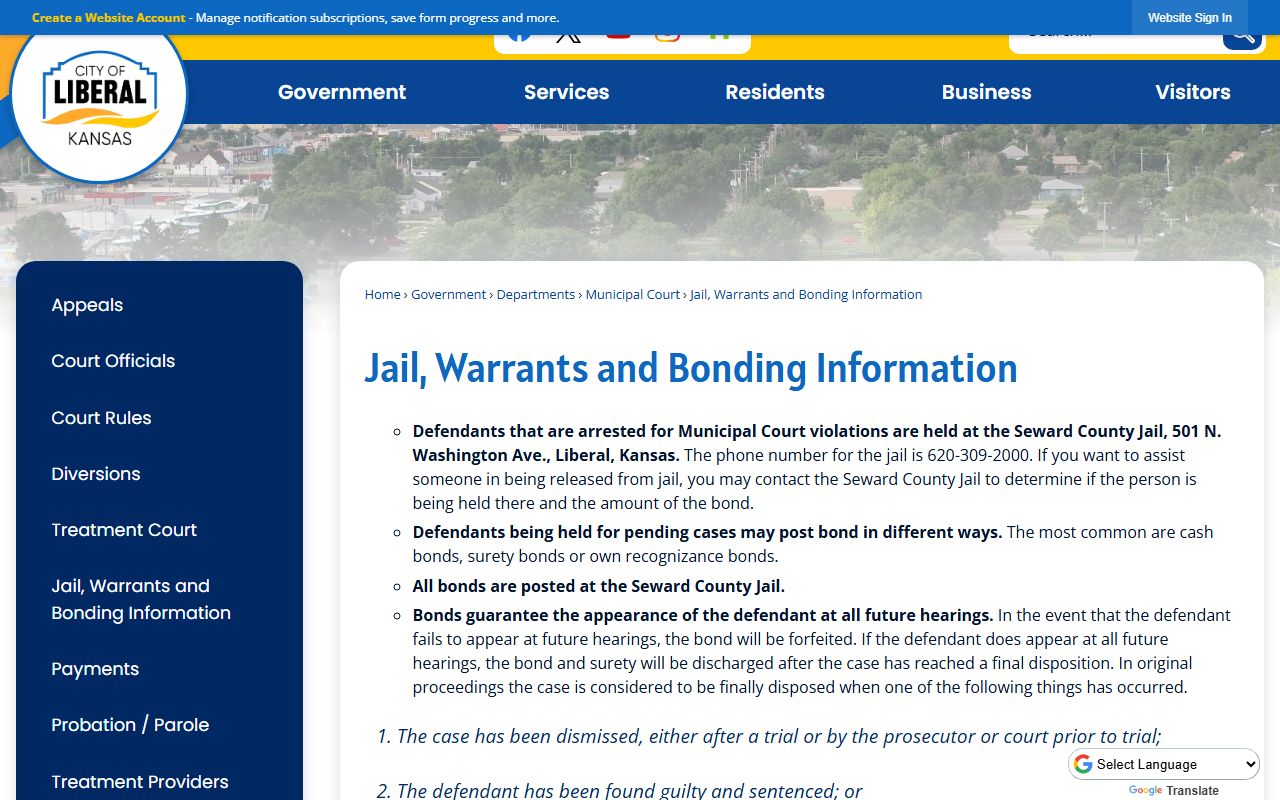
That page is municipal, so use it for Liberal city matters and use district court or the sheriff for county-level criminal cases.
Charges Convictions Sealed Expunged
Two comparisons prevent the most common mistakes in Seward County court records after a jail arrest. First, a charge is not proof of guilt. Second, a restricted record is not the same as a record that never existed. Kansas public access rules under the Kansas Open Records Act favor access to public records, but law-enforcement, juvenile, sealed, expunged, and court-controlled records may have limits.
| Point | Charge | Conviction |
|---|---|---|
| Meaning | An accusation filed after arrest or review. | A guilty plea, verdict, or judgment. |
| Proof level | May begin with probable cause. | Requires a plea or proof beyond a reasonable doubt at trial. |
| Record effect | Can be pending, amended, dismissed, diverted, or reduced. | Can affect sentence, custody, probation, KDOC tracking, and later background checks. |
A second comparison matters when a case has ended. A dismissal does not erase every public trace by itself. Sealing, expungement, or restricted access usually requires a legal basis and a court process. Kansas records law also lets some law-enforcement records be withheld when an exemption applies.
| Point | Sealed or Restricted | Expunged |
|---|---|---|
| Public view | Hidden or limited from ordinary public access. | Treated as removed from public access under the order that grants relief. |
| Agency access | Courts or law enforcement may retain limited access. | Access can still exist for specific legal purposes set by Kansas law. |
| What to check | Look for a court order or docket restriction. | Look for an expungement order, not just a dismissal line. |
Seward County Arrest Record Access Limits
When online court records do not answer the question, use the correct records path. Court filings and dockets come from the court. Jail booking records and law-enforcement records may require the Sheriff's Office or a county open-records request. The county open-records page names the County Clerk as Freedom of Information Officer and links an online KORA form. Kansas law includes K.S.A. 45-217 for public-record definitions, K.S.A. 45-218 for inspection and response rules, and K.S.A. 45-221 for records not required to be disclosed.
The Kansas Attorney General KORA FAQ says front-page standard offense reports are open, but mug shots and standard arrest reports may be closed at agency discretion. Juvenile matters, sealed records, expunged cases, active investigations, and some victim or witness details may also be withheld or redacted. For sentenced state prisoners, use the KDOC KASPER locator; for federal sentenced inmates, use the BOP locator; for immigration custody, use ICE ODLS. Those systems are not substitutes for Seward County court records.
Important: This private resource is not a consumer reporting agency and cannot be used for FCRA-covered screening.